
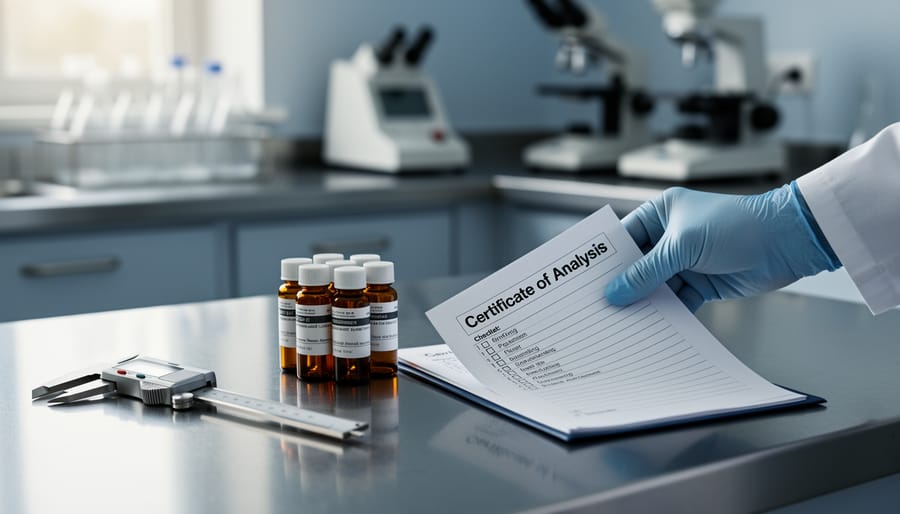
When you buy research peptides in Canada the vendor’s paperwork matters more than its pitch. A seven-point check covers it: independent testing, a Certificate of Analysis you can actually read, batch-by-batch reports, results you can find before you pay, a clear statement of who the supplier serves, realistic delivery planning, and price last. You can work through the list in about fifteen minutes per vendor, and no chemistry degree is required.
Why this order? A “+99% pure” claim on a product page is a sentence, not evidence. A published report from an accredited outside laboratory is evidence. Some suppliers show the difference plainly: Jupiter Peptides, for example, says its certificates are public, each batch is tested on its own, and the full report is posted unedited, with no account needed to see it. That’s the standard worth holding every vendor to.
If you’re a lab manager, purchasing coordinator, or researcher, this checklist gives you a repeatable way to compare suppliers and keep an audit trail. If you’re simply curious, it shows what careful sourcing looks like. This content is for research purposes only. If you or someone close to you is struggling with substance use or mental health, qualified Canadian health and addiction services are the right place to turn.
How This Laboratory Checklist Was Put Together
This list is a framework, not a ranking of vendors. The seven items reflect what suppliers typically document and how labs typically audit a vendor: quality documentation, availability, delivery reliability, safety stock, laboratory planning, and price. They follow the order a careful purchasing team might check them, with price coming last.
Where this article mentions a specific supplier, the details come only from what that supplier publicly states. They are treated as the supplier’s own claims, not as independent findings.
One thing is deliberately left out. Importation rules vary, so they aren’t covered here, and they should be confirmed with the relevant Canadian authorities and a qualified compliance contact before any order is placed.
If you landed here while looking for help with substance use or mental health, a research checklist isn’t the right resource. Try to talk to a loved one or reach out to a doctor or a trusted Canadian support service.
1. Look for Independent Third-Party Testing, Not Just a Purity Claim

A purity number on a product page is just a claim until someone independent confirms it. Anyone can print “99% pure” on a label, and a figure from the seller’s own in-house testing tells you less than a report from an outside, accredited lab with nothing to gain from the result.
That’s why the first thing to look for is third-party testing. One common method you’ll see mentioned is HPLC-UV. In plain terms, it separates the different components in a sample and measures how much of each is present, so the lab can say how much of the material is the target peptide and how much is something else.
It also helps to know who is doing the testing. Some suppliers name their labs, and that openness is useful because you can look those labs up yourself. Jupiter Peptides is an example of what this disclosure can look like. The company says all of its peptides are guaranteed +99% pure for research. It also says every active compound except one, currently, is sent to Testides, an accredited independent laboratory, for analysis by HPLC-UV. According to the supplier, other compounds go to Janoshik, which it describes as another well known and respected laboratory.
Treat these as the supplier’s own statements, not verified facts. Your job is to check them against the actual reports, which the next sections cover.
2. Read the Certificate of Analysis Line by Line
A Certificate of Analysis, or CoA, is only as useful as the details on it. A purity percentage with nothing around it tells you very little, so read the whole page rather than the headline number.
Start with purity. This is the share of the sample that is the target peptide rather than leftover fragments or by-products. Next, look at measured content against the label claim. A vial marked at a certain amount should test close to that amount. A big gap suggests the product isn’t what the label says, or that something went wrong in weighing or handling.
Then check identity confirmation. Purity tells you how clean a sample is, but not whether it’s the right compound in the first place. Identity testing answers that second question, and a CoA that skips it leaves an obvious hole.
Finally, look for bacterial endotoxin screening. Endotoxins are fragments from bacterial cell walls, and USP <85> is the standard method used to screen for them. Jupiter Peptides describes its CoAs as covering purity, measured content versus label claim and identity confirmation, plus endotoxin screening to USP <85> standards on batches where it was performed. That last phrase matters: not every batch carries an endotoxin result, so a missing line shouldn’t be read as a hidden failure, but it’s worth noting if your work needs it.
A quick checklist to run down on every CoA:
- Purity result is stated clearly.
- Measured content is shown next to the label claim.
- Peptide identity is confirmed.
- Endotoxin screening is listed, if it was performed.
- The test method is named.
- The testing lab is named.
- A batch identifier is present.
If two or three of those are missing, ask the supplier before you order. A clear answer is a good sign. Silence is useful information too.
3. Check That Reports Are Batch-by-Batch and Published in Full
A Certificate of Analysis is only as useful as the batch it describes. Peptides are made in production runs, and results from one run don’t automatically carry over to the next. If a supplier points you to a single report from months ago, you can’t be sure it reflects the vial that arrives at your lab.
That’s why batch-by-batch testing matters. Each batch should be tested on its own, with its own results. Jupiter Peptides states that each batch is tested separately, which is the standard worth looking for.
Format matters too. A summary or a single headline number can leave out the details a lab needs to judge quality. A full, unedited report lets your team read the actual results, including purity, measured content against the label claim, and identity confirmation, rather than trusting someone else’s condensed version. Jupiter Peptides says it publishes the full report unedited.
Once a report is in hand, check that it belongs to your order. Find the batch number printed on the vial and match it against the batch number on the report. If the numbers don’t line up, or the report doesn’t list a batch number at all, ask the supplier before the material goes into your workflow. It’s a quick check, and it keeps your documentation tied to what’s actually on your shelf.
4. See Whether Test Results Are Easy to Find Before You Buy

Before you order, check how easy it is to find a supplier’s test results. Some suppliers keep a public testing library, sometimes called a “COA vault,” where every Certificate of Analysis can be opened and read without signing up. That kind of openness lets you review the evidence first, then decide, instead of after money has changed hands.
Jupiter Peptides, for example, states that no account and no gate is needed, and that every certificate is public. It also says each batch is tested on its own and the full report is published unedited. Those are the supplier’s own statements, so confirm them yourself by finding a report and matching its batch number.
Other suppliers may restrict access, perhaps asking for a login, an inquiry, or proof of institutional status. That isn’t automatically a red flag. KALLCOR, for instance, says its site is for qualified researchers, laboratories, and research institutions only.
If documentation is hard to find, treat it as a question rather than a verdict. Email the supplier and ask where the reports for a specific batch live, how soon you can see them, and whether anything is withheld. A clear, prompt answer tells you a lot, and so does a vague one.
5. Understand Who the Supplier Says Its Products Are For
A trustworthy research supplier tells you plainly who it sells to. KALLCOR, for example, says its site is meant for qualified researchers, laboratories, and research institutions only. That kind of statement is worth reading closely, because it sets the terms of the relationship before you ever place an order.
So take a moment to check that your lab actually fits. Does your institutional status match the audience the supplier describes? Is your intended use a genuine research purpose? And does your own purchasing process, whether that’s a purchase order, a procurement office, or a named account holder, line up with how the supplier expects to be approached? If any of those answers feel fuzzy, ask the supplier or your compliance contact before moving forward. Importation rules aren’t covered here and should be confirmed separately with the appropriate Canadian authorities.
It’s also worth saying gently: these products are made for laboratory work, not for personal use. Nothing here is a reason for alarm, just a clear boundary. If you’re reading about peptides because of a health concern, or you’re struggling with your mental health or substance use, a licensed Canadian doctor, pharmacist, or local support service is a far better place to start. Reaching out for that kind of help is a strong, sensible step.
6. Plan Delivery, Shipping Carriers, and Safety Stock
A good test result means little if the package arrives late or sits warm on a loading dock. Before you order, ask the supplier which carriers it uses. Some may ship through Canada Post, others through UPS or another courier, so confirm rather than assume. Then run through a short planning list with your team:
- What delivery window should we expect, and how much slack can the project absorb?
- Which carrier options exist, and what tracking comes with each?
- What storage does the material need the moment it arrives?
- How much buffer stock covers the full project timeline?
- Who receives the package, and who logs it on arrival?
Delays happen, so build in a cushion. Order earlier than you think you need to, and decide in advance how much safety stock keeps a study running if one shipment slips. Running short halfway through is a bigger problem than carrying a little extra, because switching to a different batch mid-study can complicate your results. Check each delivery against the batch number on the report, and put the material into proper storage right away.
Importation rules aren’t covered in this checklist. They vary, so confirm them with the proper Canadian authorities and a qualified compliance contact before you order.
If you or someone close to you is dealing with substance use or mental health concerns, research materials aren’t the answer. Reaching out to a doctor is a good first step, and this guide on how to access support in Canada is a helpful place to start. You can also read these eight facts about addiction recovery.
7. Compare Price Last, Once Quality Documentation Checks Out

Price matters, but it belongs at the end of your audit, not the start. A low sticker price tells you very little if the documentation behind it is thin. Once a supplier has cleared testing, CoA detail and batch-level reporting, you can compare costs on fair terms.
Start by looking at price per verified milligram, not the headline number on the product page. A cheaper vial that tests below its label claim can cost more per usable milligram than a pricier one that matches. Then add shipping, since carrier fees can change the real total. Check minimum order sizes too, because they affect how much you must buy at once and how long material sits in storage.
If you’re working through a long supplier review, it’s also worth remembering to take care of yourself along the way. Procurement checklists can feel tedious, and a rested team makes fewer mistakes.
Here’s a simple audit order you can reuse for any vendor:
1. Documentation
2. Availability
3. Delivery
4. Stock
5. Planning
6. Price
Following this sequence keeps cost from steering decisions that quality should drive.
Common Questions About Buying Research Peptides Online in Canada
What is a Certificate of Analysis?
A Certificate of Analysis (CoA) is a lab document that reports what was found when a specific batch was tested. According to Jupiter Peptides, its CoAs show peptide purity, measured content versus the label claim, and peptide identity confirmation, plus endotoxin screening on batches where it was performed.
What does HPLC-UV testing mean?
HPLC-UV is a method that separates the components of a sample and measures them, which helps show how pure a compound is. Jupiter Peptides says it sends its active compounds, apart from one, to the accredited independent lab Testides for this analysis.
Why do independent labs matter more than in-house claims?
An outside lab has no stake in the sale, so its results are easier to trust than a purity figure printed on a product page. It also gives you something concrete to check rather than a promise.
Should every batch have its own report?
Yes, ideally. Jupiter Peptides states that each batch is tested on its own and the full report is published unedited, which makes it possible to match a vial’s batch number to a report.
Are research peptides meant for personal use?
No. They are intended for qualified researchers, laboratories, and research institutions, and KALLCOR states its site is for those groups only. Importation rules vary, so confirm them with the proper Canadian authorities before ordering.
Where can someone find support for mental health or substance use concerns in Canada?
A family doctor, a local health service, or a trusted Canadian support line is a good place to begin. You deserve care from a licensed professional, and reaching out is a sign of strength.
A careful lab checklist really comes down to four habits: confirm independent testing, read each CoA closely and match it to the batch in your hands, make sure the supplier’s access terms fit your institution, and plan delivery and stock before you run short. Do those well, and price becomes the easy part. And if you or someone close to you is facing mental health or substance use challenges, research products are not the answer. A doctor or a trusted Canadian support service is a good first step, and you deserve that support.