

If you’re losing sleep to anxiety and worry about becoming dependent on medication, you have options. Non-addictive anxiety medications for sleep do exist, and understanding them can help you make informed decisions with your healthcare provider. The most promising prescription option is hydroxyzine, an antihistamine with clinical evidence showing it reduces anxiety and promotes sleep without the habit-forming risks of benzodiazepines.
The concern about addiction is valid. Traditional anti-anxiety sleep medications like benzodiazepines carry real dependency risks, and current Canadian clinical guidelines don’t recommend them as first-line treatment for insomnia or anxiety disorders. Evidence shows little support for their use beyond 2 to 4 weeks, yet they’re frequently prescribed for ongoing sleep struggles.
Here’s what matters: cognitive behavioural therapies remain the recommended first approach for both insomnia and anxiety disorders, according to expert consensus. But therapy isn’t always immediately accessible, and some people need additional support while working on longer-term solutions. That’s where non-addictive medication options come in.
Beyond hydroxyzine, your doctor might consider certain off-label medications like trazodone or mirtazapine, though evidence for these remains limited. Over-the-counter options like melatonin or magnesium may offer short-term relief, but they’re not a cure and carry their own risks when used without guidance.
The path forward involves honest conversations with your healthcare provider about what’s keeping you awake, what you’ve tried, and what concerns you most about treatment options. You deserve sleep without sacrificing your long-term wellbeing.
Why Anxiety Keeps You Awake (And Why It Matters)
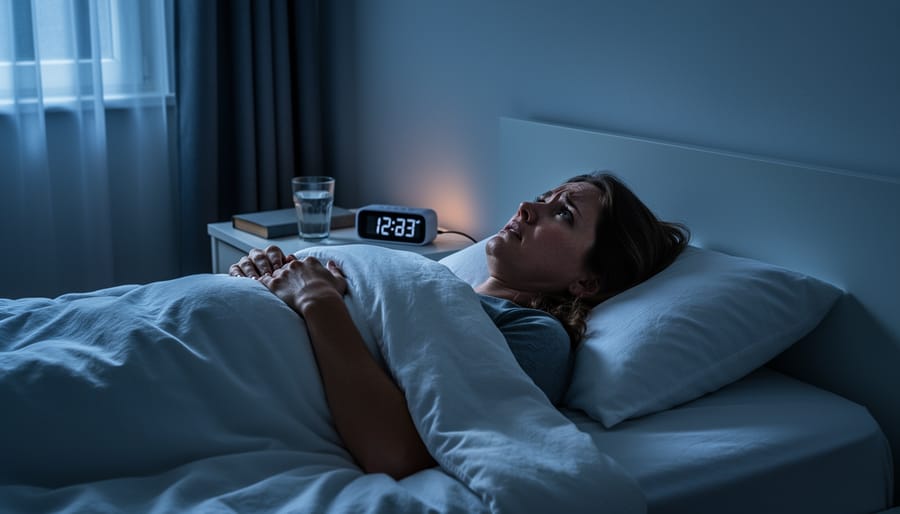
Your mind races the moment your head hits the pillow. Your heart pounds. Your muscles stay tense despite your exhaustion. This isn’t just stress keeping you awake, it’s anxiety hijacking your body’s ability to rest.
When you experience chronic anxiety your nervous system stays in a heightened state of alert. Think of it as a smoke alarm that won’t turn off even after the danger has passed. This constant activation floods your body with stress hormones like cortisol and adrenaline, which directly interfere with the natural sleep-wake cycle your body depends on.
The physical symptoms make things worse. Racing thoughts prevent your mind from quieting down. Muscle tension creates discomfort that makes it hard to settle. Shallow, rapid breathing keeps your body in “fight or flight” mode instead of the relaxed state sleep requires. For people with generalized anxiety this cycle repeats night after night, creating a pattern where worry about not sleeping becomes another source of anxiety.
Here’s why this matters beyond feeling tired: poor sleep intensifies anxiety symptoms, which then makes sleep even harder to achieve. You’re caught in a feedback loop where each problem feeds the other. Breaking this cycle requires addressing both issues together, not treating them as separate concerns.
You’re not broken, and you’re not imagining the connection between your anxiety and sleepless nights. Understanding how they interact is the first step toward finding solutions that actually work.
What Makes a Medication ‘Non-Addictive’?
When you’re searching for medication to help with both anxiety and sleep, understanding what makes something “non-addictive” matters. The terms get thrown around a lot, but they have specific meanings that affect your safety and treatment options.
- Addiction
- A compulsive pattern of drug-seeking behaviour despite harmful consequences, driven by changes in the brain’s reward system. It involves craving the medication and losing control over its use.
- Dependence
- When your body adapts to a medication and needs it to function normally, which can happen with many medications including some that aren’t addictive. Stopping abruptly may cause withdrawal symptoms.
- Tolerance
- When your body gets used to a medication over time, requiring higher doses to achieve the same effect. This is separate from addiction but can contribute to addiction risks.
- Withdrawal
- Physical or psychological symptoms that occur when stopping a medication your body has adapted to. Experiencing withdrawal doesn’t automatically mean you were addicted.
Non-addictive medications work differently in your brain. They don’t trigger the reward pathways that make you crave more or compulsively seek the drug. Medications like hydroxyzine calm your nervous system without creating that dependence loop. Your brain doesn’t develop the same chemical need for them that happens with habit-forming substances.
This distinction is crucial because it means you can address your anxiety and sleep problems without the fear that you’re trading one problem for another. Non-addictive options still require proper medical supervision and shouldn’t be stopped abruptly, but they don’t carry the same risk of compulsive use that keeps many people awake at night worrying about their treatment.
Non-Addictive Prescription Options for Anxiety-Related Sleep Problems
Hydroxyzine: The Antihistamine That Calms
Hydroxyzine works differently than typical sleep medications. As an antihistamine, it blocks histamine receptors in your brain, the same ones that keep you alert during the day. This creates a calming effect that can reduce anxiety while making you drowsy, without activating the brain pathways associated with addiction.
Your doctor might prescribe hydroxyzine hydrochloride (often called Atarax) or hydroxyzine pamoate (Vistaril). Both work the same way, just in different formulations. The sedating effect typically kicks in within 30 minutes to an hour, which is why it’s often taken before bedtime.
Clinical evidence shows hydroxyzine can reduce anxiety and promote sleep without habit-forming potential. It doesn’t create the physical dependence that benzodiazepines do, and you won’t build tolerance requiring higher doses over time. That said, “non-addictive” doesn’t mean side-effect-free. You might experience dry mouth, grogginess the next morning, or dizziness, especially when you first start taking it.
Hydroxyzine might benefit you if you struggle with situational anxiety that disrupts your sleep, or if you need something for short-term use while working on longer-term solutions like therapy. It’s not typically recommended as a permanent fix, but it can provide relief when you need it most.
Some people find hydroxyzine less effective over weeks of continuous use, though this varies. Your healthcare provider will help determine whether it’s appropriate for your specific situation and how long you should use it.
Other Prescription Options with Limited Addiction Risk
Several prescription medications may be used for anxiety-related sleep problems, even though they weren’t specifically designed as sleep aids. These options carry low addiction potential, but it’s crucial to understand that “non-addictive” doesn’t automatically mean “right for you.”
Trazodone, an antidepressant, is frequently prescribed off-label for insomnia at lower doses than those used for depression. It can help you fall asleep and may reduce anxiety, though drowsiness the next day is common. Mirtazapine, another antidepressant, has sedating effects that some people find helpful for sleep, particularly at lower doses. It may also improve appetite, which can be a benefit or drawback depending on your situation.
Quetiapine, an antipsychotic, is sometimes prescribed at low doses for sleep, though this practice is controversial given potential side effects like weight gain and metabolic changes. Amitriptyline, a tricyclic antidepressant, has sedating properties but comes with its own side effect profile, including dry mouth and constipation.
Your doctor might consider these medications when anxiety and sleep problems persist despite other approaches, or when you have co-existing depression. The choice depends on your complete health picture, other medications you’re taking, and specific symptoms. What works for someone else may not be the best fit for you, which is why individual medical guidance matters more than any general recommendation.
What About Benzodiazepines?
You might have seen benzodiazepines mentioned for sleep or anxiety, and you’re right that some shorter-acting ones like estazolam and triazolam are FDA-approved for insomnia. Here’s what’s important to understand: approved doesn’t automatically mean recommended.
Canadian guidelines are clear that benzodiazepines not first-line treatment for insomnia or anxiety disorders. This isn’t about judgment. It’s about evidence. Research shows there’s no substantial support for benzodiazepine use beyond two to four weeks for the conditions they’re frequently prescribed for, including anxiety and insomnia.
The concern isn’t just addiction potential, though that’s real. It’s also about effectiveness over time. Your body adapts, meaning what helps initially often stops working, yet stopping can be difficult. Some people develop tolerance quickly. Others experience rebound anxiety or insomnia when trying to discontinue.
This doesn’t mean benzodiazepines are never appropriate. In specific situations, under careful medical supervision, they might play a short-term role. But if you’re looking for sustainable relief from anxiety-related sleep problems, they’re not where most healthcare providers will start, and for good reason.
If a doctor suggests a benzodiazepine, it’s fair to ask why, what the plan is for duration, and what alternatives might work instead. You deserve answers that make sense for your situation.
Over-the-Counter and Natural Approaches

You’ve probably walked past shelves of sleep aids at the pharmacy and wondered if one might help without the risks you’re trying to avoid. The honest answer is that over-the-counter options can offer some relief, but they come with limitations worth understanding.
Melatonin is the most popular choice. It’s a hormone your body naturally produces to regulate sleep-wake cycles, and taking it as a supplement can help if your internal clock is off. For anxiety-related sleep problems, though, the evidence is mixed. It might help you fall asleep faster, but it doesn’t address the underlying anxiety keeping you awake. Doses in Canada typically range from 1 to 10 mg, and more isn’t always better. Some people find it helpful short-term, while others notice little difference.
Magnesium supplements have gained attention for both sleep and anxiety. Magnesium plays a role in relaxation and nervous system regulation, and deficiency can worsen both problems. That said, most people get enough from food, and supplementing won’t necessarily improve sleep if you’re not deficient. Different forms (glycinate, citrate, oxide) are absorbed differently and may affect digestion.
L-theanine, an amino acid from tea, and valerian root are other options people try. The research supporting them is limited, and results vary widely between individuals.
Here’s what matters: these aren’t medications designed to treat anxiety disorders. They might take the edge off or help on particularly rough nights, but they won’t provide the same relief as evidence-based treatments. Combining them with proven anxiety attack techniques tends to work better than relying on supplements alone. And yes, natural doesn’t automatically mean safe. Melatonin can cause morning grogginess, magnesium may lead to digestive issues, and interactions with other medications are possible.
Think of OTC options as tools that might help while you’re working on longer-term solutions, not as standalone answers.
The First-Line Approach: Therapy Before Medication
Before you fill a prescription, Canadian healthcare guidelines recommend starting with therapy. This isn’t about making you jump through hoops or dismissing your need for relief, it’s about giving you tools that work long-term without side effects.
Cognitive behavioural therapy for insomnia (CBT-I) is recognized as CBT-I first-line in Canada for treating chronic sleep problems. It teaches you to identify and change thoughts and behaviours that interfere with sleep. You’ll learn practical techniques like stimulus control (using your bed only for sleep), sleep restriction (consolidating your sleep into fewer, more solid hours), and relaxation strategies. Unlike a pill that stops working when you stop taking it, CBT-I gives you skills that last.
For anxiety itself, standard CBT helps you recognize anxiety patterns and develop coping strategies that reduce both daytime worry and nighttime racing thoughts. Sessions might involve exposure to anxiety triggers in controlled ways, challenging catastrophic thinking, or practicing grounding techniques you can use at 2 a.m. when your mind won’t quiet.
The therapy-first approach isn’t about avoiding medication forever. It’s about building a foundation that makes any medication you do take work better, and potentially allows you to use less of it or for a shorter time. Some people find therapy alone resolves their sleep and anxiety issues. Others use it alongside medication, then taper the medication once their skills are solid. There’s no one-size-fits-all answer, but starting with evidence-based therapy gives you the most options moving forward.
How to Talk to Your Healthcare Provider
Walking into an appointment worried about sleep and anxiety can feel overwhelming, especially when you’re concerned about addiction risk. Preparation helps. Before you go, track your sleep patterns for a week or two: when you go to bed, how long it takes to fall asleep, how often you wake up, and how you feel during the day. Note what makes your anxiety worse and what helps. If you’ve taken free anxiety tests online, bring those results as a starting point for conversation, though your provider will do their own assessment.
Be direct about your concerns. Say something like, “I’m struggling with anxiety that’s affecting my sleep, and I’m worried about becoming dependent on medication. What are my options?” This opens the door to discussing non-addictive alternatives first. Ask specific questions: How does this medication work? Is it habit-forming? What are the risks and benefits? How long would I need to take it? Are there non-medication approaches we should try first?
Share what you’ve already tried, even if it didn’t work. That information helps your provider understand your situation better and avoid suggesting things you’ve already ruled out. If you’re in Canada, you can also ask about wait times for cognitive behavioural therapy or other talk therapy options covered by your province, since these are recommended as first-line treatment.
Don’t be afraid to push back if something doesn’t feel right or to ask for a second opinion. Good providers welcome questions and respect your concerns about safety.

Finding relief from anxiety-related sleep problems without risking addiction isn’t about choosing between rest and safety, you can have both. The options we’ve explored, from hydroxyzine to cognitive behavioural therapies, prove that non-addictive approaches exist and work for many people. Your concerns about medication dependence are legitimate and worth discussing openly with your healthcare provider.
There’s no one-size-fits-all solution, and what works for someone else might not be right for you. That’s okay. The journey to better sleep and reduced anxiety often involves some trial and adjustment, working closely with a provider who understands your specific situation and respects your concerns.
Taking the first step, whether that’s booking an appointment, trying a therapy approach, or having an honest conversation about your worries, takes courage. You’re not weak for needing help with sleep and anxiety. You’re taking control of your health and making informed choices that prioritize both your wellbeing and your long-term safety. That’s something to feel good about.